Tourist guide

Driving in Spain

Complete guide for tourists and expats. Learn the road rules, speed limits, and essential information before you drive in Spain.

Right sideDriving side
120km/hMax highway speed
112Emergency number

Briefing

Driving in Spain in 2026 means dealing with three things the rest of Europe mostly doesn't: the V-16 connected emergency beacon, the patchwork of Zonas de Bajas Emisiones (ZBE), and the steady disappearance of peajes on what used to be toll motorways. As of 1 January 2026 the V-16 conectada is the only legal way to mark a stopped vehicle on Spanish roads — the orange beacon goes on the roof and pings its GPS position straight to the DGT 3.0 platform, replacing the two warning triangles.

The rule binds Spanish-registered and rental cars; foreign-registered vehicles still use triangles, but if you're renting in Spain the V-16 should already be in the glovebox.

The ZBE rollout is the other change you'll notice immediately. Since 1 January 2023 every Spanish city above 50,000 inhabitants is legally required to operate one, and by early 2026 around 56 cities have them fully active with cameras issuing fines — Madrid Central (now ZBE Distrito Centro), Barcelona's ZBE Rondes, Sevilla, Valencia, Bilbao, Valladolid, A Coruña.

You need a DGT environmental sticker (0, ECO, C, B) stuck to the windscreen; without one, plate-recognition cameras issue 200 EUR fines automatically. Rentals come pre-stickered, but check before you drive.

Big-city specifics worth knowing: Madrid's SER parking system uses blue (visitors) and green (resident-priority) zones, charges around 2.85 EUR/hour, and gives free parking to zero-emission cars. The M-30 ring is tunneled in long sections and enforces a 70 km/h limit with average-speed radars — the famous "radares de tramo" — so braking before a fixed gantry won't save you.

In Catalonia, large chunks of the AP-7 went toll-free on 1 September 2021 along with the AP-2, and Alicante's AP-7 ring was made permanently free in February 2026; the AP-68 Bilbao–Zaragoza is still tolled and at around 40 EUR end-to-end remains one of the most expensive in the country.

One regional quirk: in rural Galicia, Asturias and parts of the Basque Country, two-lane carreteras convencionales often have a 90 km/h posted limit but blind curves that locals take at half that — and the Guardia Civil's mobile radars know the lay-bys.

Can you drive in Spain?

Accepted licenses from

EUEEASwitzerlandUSACanadaAustraliaUK
Validity period

EU/EEA licenses valid indefinitely while current; non-EU/EEA licenses valid for 6 months from when the holder establishes residence in Spain. Tourists can drive on a non-EU licence for the duration of their stay if it conforms to the Vienna or Geneva Convention, otherwise an IDP or official Spanish translation is required

Important note

After 6 months of residence, non-EU licence holders must exchange (canje) their licence if Spain has a bilateral agreement with the issuing country, or take a new Spanish test if not. IDP is a complement to the original licence, not a replacement

What to carry in your car

Mandatory items

  • V-16 connected emergency beacon (mandatory in Spanish-registered and rental vehicles from 1 January 2026; replaces warning triangles)
  • Two warning triangles (required for foreign-registered vehicles entering Spain)
  • Reflective high-visibility vest (one per occupant recommended; one mandatory for the driver)
  • Valid driving licence
  • Vehicle registration document (permiso de circulación)
  • Technical inspection card (ficha técnica / ITV) for Spanish-registered cars
  • Valid insurance certificate
  • Passport or national ID card

Recommended items

  • First aid kit
  • Spare bulbs and fuses
  • European accident statement form (declaración amistosa de accidente)
  • DGT environmental sticker (distintivo ambiental) — required to enter any ZBE

Speed limits

Urban areas

km/h *

Rural roads

km/h

Highways/motorways

km/h

* Urban: 30 km/h with one lane per direction, 50 km/h with two or more, 20 km/h on single-platform streets (RD 970/2020).

Test your knowledge of Spain traffic rulesFree practice questions based on official test material.Start practicing

Toll roads

Payment methods

  • Cash
  • Credit/debit card
  • Contactless
  • Via-T electronic tag
Average cost

Typically 7-12 EUR per 100 km on remaining tolled autopistas (e.g. AP-68, AP-66, AP-8, AP-9)

Many former toll autopistas are now free, including the AP-7 in Catalonia and AP-2 (free since 1 September 2021) and the AP-7 ring of Alicante (permanently free from February 2026). The AP-68 Bilbao–Zaragoza remains tolled, around 40 EUR end-to-end. Free alternatives (autovías and carreteras nacionales) usually exist

Parking

Line colors

Blue

Paid short-stay parking for visitors (zona azul, SER/ORA)

Green

Resident-priority paid parking (zona verde) — non-residents pay higher rates and have shorter max stays

Yellow

No parking / loading zone

White

Free parking (where present)

Red

Loading and unloading only (carga y descarga)

Parking tips

  • Pay at the parquímetro machine and display the ticket on the dashboard, or use city apps (e.g. Madrid SER, ApparkB in Barcelona)
  • Zero-emission cars (DGT label 0) park free in Madrid SER zones; ECO cars get a 50-75% discount
  • Parking fines (zona azul/verde) are typically 90 EUR, reduced to 45 EUR if paid within 20 days; overstays under 30 min can often be cancelled at the meter with a small "anulación" ticket
  • Shopping-centre parking is often free for 1-2 hours with a purchase validation
Average cost

Around 2.85 EUR/hour in Madrid SER zones; 1-3 EUR/hour typical across other city centres

Common mistakes tourists make

  1. Driving without the V-16 connected beacon in a Spanish-registered or rental car (mandatory from 1 January 2026; 80 EUR fine)
  2. Entering a ZBE without a DGT environmental sticker on the windscreen — Madrid, Barcelona, Valencia, Sevilla and 50+ other cities issue automatic 200 EUR fines via camera
  3. Confusing 30 km/h streets (single lane per direction) with 50 km/h streets (two+ lanes) under the urban-speed reform
  4. Parking in a green (resident) zone without paying the higher visitor tariff
  5. Forgetting to switch on headlights in tunnels and on rainy motorways
  6. Ignoring priority to the right at unmarked urban junctions
  7. Underestimating tramo (average-speed) radars — common on M-30, A-7 sections and mountain passes

Traffic fines

Speeding
100-600 EUR plus 0-6 points (no points if 100 EUR; 6 points and 600 EUR at top tier). Over 80 km/h above limit becomes a criminal offence
No seatbelt
200 EUR + 4 points
Phone use
200 EUR + 6 points for handheld use (doubled from 3 points in 2022 reform)
Red light
200 EUR + 4 points
Illegal parking
Typically 90-200 EUR; SER zone violations 90 EUR (45 EUR with 20-day early payment)

Can you pass the test?

Try a few real practice questions

Start practicing

Spain practice questions

Question 1 of 5
Free practice

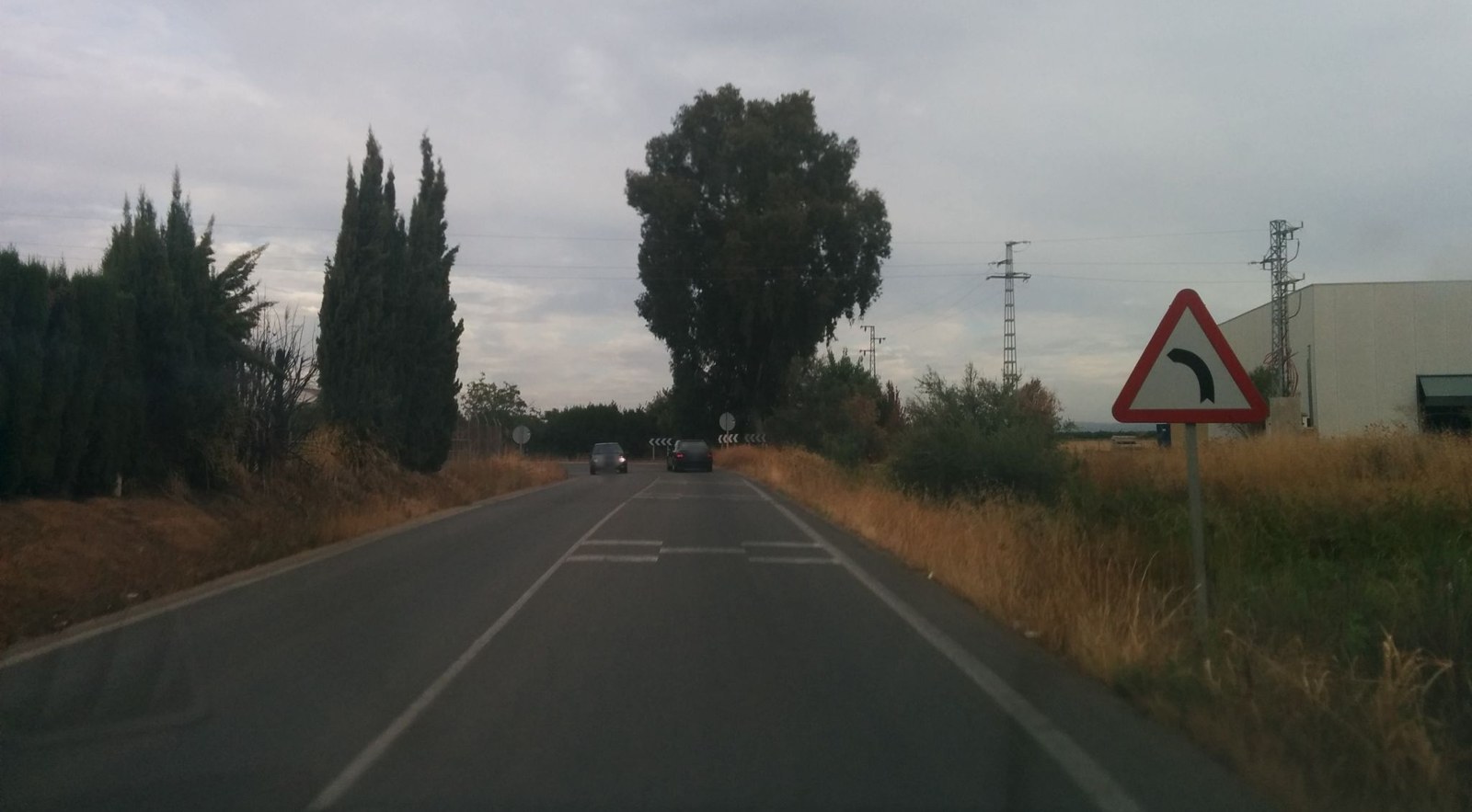
You are driving along this road towards the chevrons. What does the sign on the right warn you about?

Free practice questions based on official test material.

Emergency contacts

Police112(general) / 091 (Policía Nacional, urban) / 062 (Guardia Civil, rural and interurban roads) / 092 (Policía Local)
Ambulance112(general) / 061 (medical emergencies)
Fire112(general) / 080 (Bomberos, local) / 085 (Bomberos provincial)
Roadside assistanceRACE: 900 100 992 · RACC: 900 365 505 (Catalonia)

Want to master Spain driving rules?

Practice with our driving test questions and learn all the rules before you drive.

Driving guides for other countries