Tourist guide

Driving in Germany

Complete guide for tourists and expats. Learn the road rules, speed limits, and essential information before you drive in Germany.

Right sideDriving side
130km/hMax highway speed
112Emergency number

Briefing

Germany's autobahn network is the defining feature of driving here, and also the most misunderstood. There is no general speed limit on roughly 70 percent of the autobahn, but the Richtgeschwindigkeit (advisory speed) sits at 130 km/h under §1 of the Autobahn-Richtgeschwindigkeits-Verordnung.

The catch most foreign drivers miss: a 1992 Bundesgerichtshof ruling (VI ZR 62/91) means that if you crash above 130, your insurer can apportion partial liability for erhöhte Betriebsgefahr — increased operating risk — even when you didn't cause the accident. So "no limit" is not "no consequence".

Posted limits cover more of the network than tourists expect. The A9 around Munich, the A8 over the Schwäbische Alb between Stuttgart and Karlsruhe, and the A10 Berliner Ring all have long Tempolimit-Strecken managed by electronic Schilderbrücken (gantry signs) that drop the limit dynamically during rain, fog or heavy traffic.

The A8 Stuttgart–Karlsruhe is also one of the country's worst Stau bottlenecks; ADAC's 2025 Staubilanz ranked it second nationally for summer congestion, with the climbs in the Northern Black Forest a persistent choke point.

In cities, Umweltzonen are now a single-tier system. Every one of Germany's 36 environmental zones — Berlin, Hamburg, Munich, Cologne, Stuttgart, Frankfurt, and a long list of mid-sized cities including the entire Ruhrgebiet — requires the grüne Plakette (Schadstoffgruppe 4).

Red and yellow stickers are no longer valid anywhere. Stuttgart, Munich and Darmstadt layer additional Diesel-Fahrverbote on top.

Two recent changes worth noting. The StVO-Novelle of November 2021 sharply raised parking and speeding fines; the figures below reflect that overhauled Bußgeldkatalog (last revised October 2024).

And as of 22 August 2024, the Sechstes Gesetz zur Änderung des Straßenverkehrsgesetzes introduced a THC blood-serum limit of 3.5 ng/ml — the first numerical cannabis-driving threshold in German law — with a €500 fine, one-month ban and two Punkte for a first offence. The Niedersachsen Section-Control pilot on the B6 near Hannover was switched off in early 2024 after Jenoptik stopped supporting the system, so average-speed enforcement is currently not in use anywhere in Germany.

Germany has no general car toll. The PKW-Maut was struck down by the ECJ in June 2019 (Case C-591/17) and has not been revived.

Trucks over 7.5 t pay the Lkw-Maut; private cars pay only on a handful of private tunnels such as the Warnowtunnel in Rostock and the Herrentunnel in Lübeck.

Can you drive in Germany?

Accepted licenses from

EUEEASwitzerlandUSACanadaAustraliaUKJapan
Validity period

EU/EEA licences valid indefinitely; non-EU tourist licences valid for up to 6 months from entry. After establishing residency in Germany, non-EU holders must convert or pass tests within 6 months (varies by issuing country under Anlage 11 FeV).

Important note

Non-EU licences not in Latin script require either an International Driving Permit (1968 Vienna Convention) or a certified German translation (ADAC, ACE or sworn translator). UK licences remain accepted post-Brexit for tourist use.

What to carry in your car

Mandatory items

  • Warning triangle (Warndreieck)
  • First-aid kit conforming to DIN 13164:2022 (two medical face masks now required; older 1998/2014 kits remain valid if contents are not expired)
  • Reflective high-visibility vest (Warnweste, EN ISO 20471) — one per vehicle
  • Valid driving licence
  • Vehicle registration (Zulassungsbescheinigung Teil I)
  • Proof of motor insurance (insurance is mandatory; physical green card no longer required for EU-registered vehicles)

Recommended items

  • Spare bulbs (not legally mandatory for vehicles with self-diagnosis)
  • Winter tyres with the 3PMSF Alpine symbol — required under §2(3a) StVO whenever there is snow, ice, slush or black ice (situative Winterreifenpflicht); M+S-only tyres no longer accepted since 1 October 2024
  • Umweltzone sticker (grüne Plakette) for any vehicle entering one of the 36 environmental zones

Speed limits

Urban areas

km/h

Rural roads

km/h

Highways/motorways

km/h *

* Recommended on unrestricted Autobahn sections

Test your knowledge of Germany traffic rulesFree practice questions based on official test material.Start practicing

Parking

Line colors

Blue zone

Free but time-limited; Parkscheibe (cardboard parking disc) showing arrival time required

White lines

Regulated parking — usually paid via Parkscheinautomat or app (EasyPark, ParkNow, PayByPhone)

Yellow lines or hatching

No stopping (Halteverbot) — only loading/unloading where signed

Parking tips

  • In blue zones, set your Parkscheibe to the next half-hour after arrival; failure to display one is treated as a parking violation
  • Many city Tiefgaragen accept contactless card payment on exit; some still require validation at a Kassenautomat first
  • On narrow streets, look for "halb auf dem Gehweg" signs (B315) that permit half-mounting the kerb — assuming this without the sign is a fine
  • Residents-only zones are marked "Bewohner mit Parkausweis" — fines apply even at night
Average cost

€1.00–€4.00 per hour at street meters in city centres; Tiefgarage rates typically €2.00–€3.50/hour or €15–€25/day in Munich, Hamburg, Frankfurt and Berlin Mitte.

Common mistakes tourists make

  1. Cruising in the left lane on an autobahn — Rechtsfahrgebot (§2 StVO) requires you to return to the right after overtaking; police can fine €80 for blocking
  2. Overtaking on the right (Rechtsüberholen) on the autobahn — illegal except in stop-and-go traffic; €100 fine and 1 Punkt
  3. Ignoring the Rettungsgasse rule: when traffic stops on a 2+ lane road, leave a corridor between the leftmost lane and the lane to its right (not down the middle). Failing to form one is €200 and 2 Punkte
  4. Entering an Umweltzone without the grüne Plakette — €100 fine, applies even to foreign-registered cars
  5. Running out of fuel on the autobahn — treated as an avoidable stop under §18(8) StVO and finable
  6. Driving in snow or slush on M+S-only tyres after 1 October 2024 — only the 3PMSF Alpine symbol is now accepted under situative Winterreifenpflicht
  7. Assuming the 130 km/h Richtgeschwindigkeit has no legal consequence — your insurer can reduce payouts after a crash at higher speed (BGH VI ZR 62/91)

Traffic fines

Speeding
€20 (10 km/h over, outside built-up areas) to €800 (over 70 km/h over, inside built-up areas). 1 Punkt in Flensburg from 21 km/h over; one-month driving ban from 31 km/h over inside cities or 41 km/h over on autobahns.
No seatbelt
€30 (driver or adult passenger). €60 plus 1 Punkt if an unrestrained child is carried; €70 if multiple children unrestrained.
Phone use
€100 and 1 Punkt for handheld use while driving. €150 if it endangered others, €200 if it caused property damage (both add a one-month ban and a second Punkt). Same penalties apply at red lights and to tablet/laptop use.
Red light
€90 and 1 Punkt for a simple violation (light red less than one second). €200, 2 Punkte and a one-month ban for a qualified violation (red over one second); rises to €320 with endangerment or €360 with property damage.
Illegal parking
€10–€15 simple wrong parking; €25–€55 with obstruction; €55 on a disabled bay or in front of a dropped kerb; €55–€100 on the pavement, bike lane, fire lane or causing emergency-vehicle obstruction (with 1 Punkt). Schedule reflects the StVO-Novelle of 9 November 2021.

Can you pass the test?

Try a few real practice questions

Start practicing

Germany practice questions

Question 1 of 5
Free practice

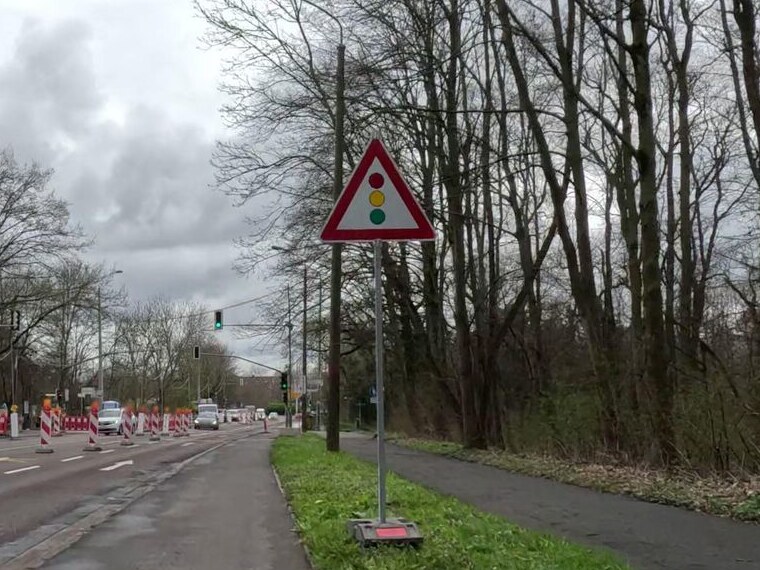
What must you expect after this sign, and how do you drive on?

Free practice questions based on official test material.

Emergency contacts

Police110
Ambulance112
Fire112
Roadside assistanceADAC: 22 22 22 from German mobile networks; 089 20 20 4000 from landlines or abroad (+49 89 22 22 22). Non-members are served at cost.

Want to master Germany driving rules?

Practice with our driving test questions and learn all the rules before you drive.

Driving guides for other countries