Direction Signs
Guide drivers to destinations, exits, and distances.
3 signs in this category
About Direction Signs
Direction, position and indication signs are defined in Annex 1, Section G of the 1968 Vienna Convention on Road Signs and Signals. Section G is the largest single category by article count and includes advance direction signs displayed before the junction, direction signs at the junction itself, place identification signs at the entry and exit of localities, route confirmation signs after the junction, motorway exit signs, kilometre posts and lane-management arrow panels above the carriageway. The Convention permits rectangular panels with the destination or symbol shown on a green ground for motorways, a blue ground for ordinary roads, a yellow ground for temporary diversions and a white ground for local destinations; arrow-headed rectangles are used for direction signs proper.
The defining driver-action principle of Section G is navigational: the signs guide drivers along a route and identify exits, lanes, destinations and distances, but do not in themselves prohibit or compel any specific manoeuvre. Where a Section G arrow appears in combination with a Section D mandatory disc — for instance an overhead lane-control panel showing a compulsory direction — the mandatory obligation under Section D takes legal priority over the merely directional indication.
All Direction Signs
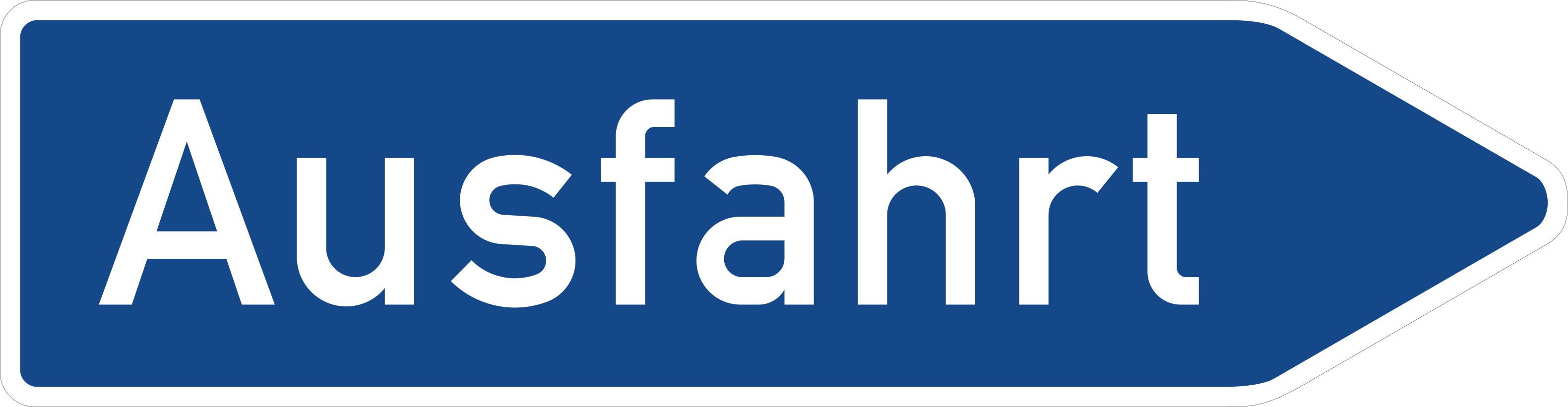
Motorway Exit
Identifies an upcoming motorway exit by exit number, destination name and distance. On motorways the standard ground is green with white legend; on ordinary roads the ground is blue with white legend.
- When you see it
- In a sequence — typically at 2000m, 1000m and 500m before the exit, with a final confirmation at the gore — on motorways and grade-separated expressways.
- What you must do
- If you intend to take the exit you must move into the deceleration lane in good time, signal, and reduce speed only once you are clear of the through-lanes.
- Country variations
- Some Vienna parties (Italy, France) use white-on-green for motorways and white-on-blue for ordinary roads; others (Sweden, the Netherlands) reverse the convention so that motorways are blue. Both schemes are permitted under Section G.
Source: Vienna 1968 Section G
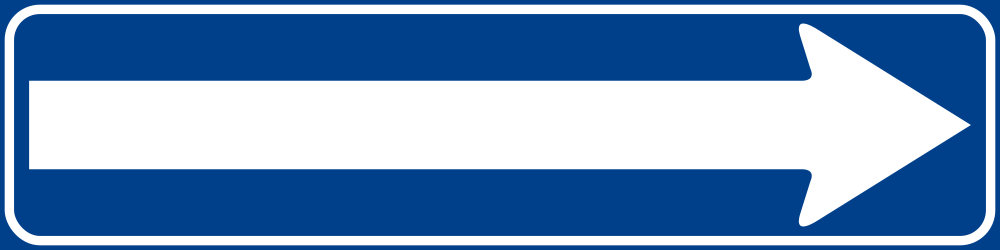
One-way Traffic
Designates a one-way street. Traffic on this road flows only in the direction shown by the white arrow on the blue rectangular ground.
- When you see it
- At the entry to one-way streets in urban areas, typically paired with a Section C.1 no-entry sign at the contraflow end of the same street.
- What you must do
- You must travel only in the direction shown by the arrow. You shall not reverse against the flow except for short manoeuvres into a parking space.
Source: Vienna 1968 Section E.3
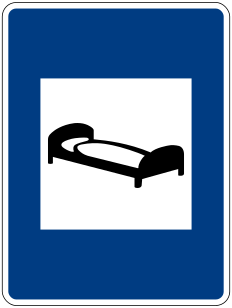
Hotel or Motel
Indicates a hotel or motel accessible from the road. The pictogram is a stylised bed on a white inset square; some Vienna parties use a knife-and-fork or coffee-cup variant to distinguish lodging from a restaurant.
- When you see it
- On motorway approach panels and at exits leading to service areas with lodging, and on rural primary roads to mark accommodation, typically with distance information.
- What you must do
- You may leave the main road to use the facility; the sign imposes no driving restriction in itself. You should remain alert to merging and slow-moving traffic at the exit.
Source: Vienna 1968 Section F.5
Key Information About Direction Signs
How to Recognize
Direction signs are rectangular, often with arrows. Color varies by road type.
Required Action
Follow the indicated direction to reach your destination.
Penalties
Wrong-way driving can result in heavy fines and is extremely dangerous.
Explore Other Categories




Ready to Ace Your Driving Test?
Everything you need to pass on your first attempt
- 30+ Practice Tests
- 16 Lessons
- Progress Tracking
- Tess AI Coach