Know what every road sign means
38 signs grouped by what they do — each with its shape, its colours, and exactly when you see it on the road.
Free to browse — no signup. Every sign with its shape, colours and what it means.
These are the road signs of the 1968 Vienna Convention, used across Europe and in more than 80 countries. Some countries — including the United States — use a different system, so check your own country's guide before your test.
Last updated: May 27, 2026
Sign Categories
Browse road signs organized by their type and purpose.
Warning Signs
Alert drivers to potential hazards ahead. Usually triangular with red border.
12 signs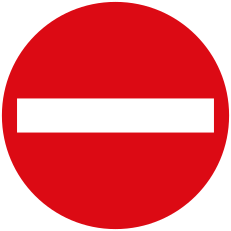
Prohibitory Signs
Indicate actions that are not permitted. Usually circular with red border.
7 signs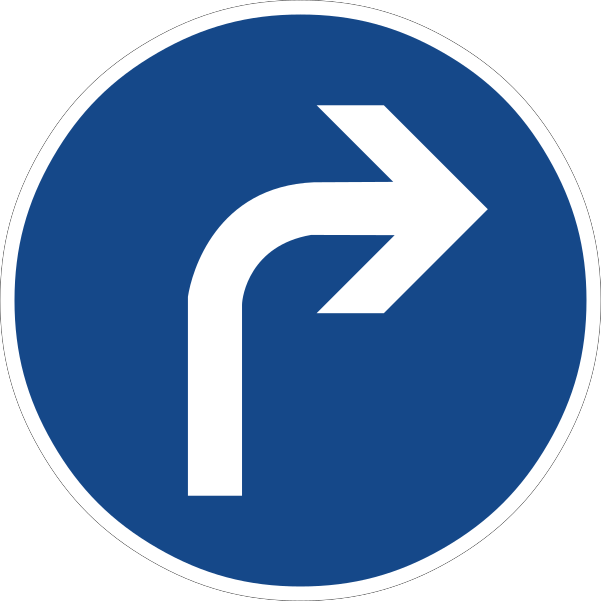
Mandatory Signs
Indicate required actions or directions. Usually circular with blue background.
3 signs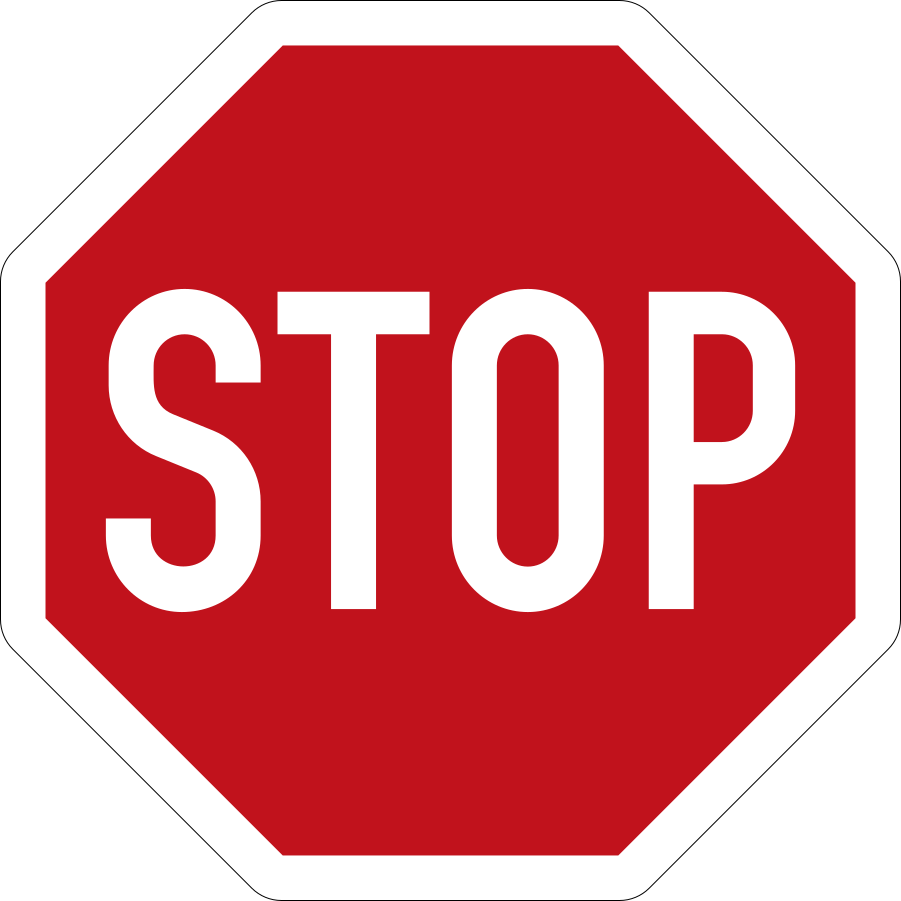
Priority Signs
Indicate who has right of way at intersections. Various shapes and colors.
5 signs
Informative Signs
Provide useful information about facilities, services, and locations.
6 signs
Direction Signs
Guide drivers to destinations, exits, and distances.
3 signs
Zone Signs
Indicate special areas like school zones, pedestrian areas, and work zones.
2 signs
One from each category
A sign from every group, so you can see how the shapes and colours differ.
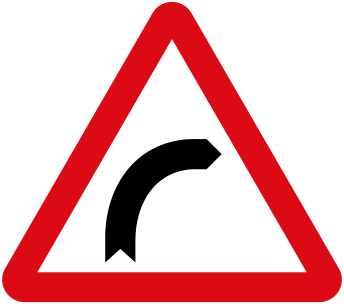
Curve Ahead
Warns that the road ahead contains a dangerous bend or a sequence of bends; the curve direction shown by the symbol indicates the first bend.
- When you see it
- You see this sign on the approach to a sharp single bend, a hairpin or a series of bends that cannot be read in time from the road geometry alone.
- What you must do
- You must reduce speed before entering the bend, stay in your lane and refrain from overtaking until the road geometry is again clear.
- Tip
- The direction of the curve is shown by the arrow on the sign.
Source: Vienna 1968 Section A.1a
No Entry
Prohibits entry to all vehicles. The sign is shown in the direction in which entry is forbidden and is most often used to mark the exit end of a one-way street or a closed road.
- When you see it
- You see this sign at the contraflow end of one-way streets, at closed roads, at the exit ramps of motorways viewed in the wrong direction, and at restricted-access courtyards.
- What you must do
- You must not enter the road past this sign. You shall turn back or follow the alternative route indicated.
- Penalty
- Penalties for ignoring this sign vary by country. See your country's driving guide for specifics.
Source: Vienna 1968 Section C.1
Turn Right
Indicates the single direction in which vehicles are required to proceed past the sign — in this variant, to the right. Other arrow orientations cover left, straight, straight-or-right and straight-or-left.
- When you see it
- You see this sign at junctions and channelised exits where only one direction of travel is permitted, typically to keep a one-way scheme functioning or to enforce a banned manoeuvre.
- What you must do
- You must follow the direction shown by the arrow. You shall not proceed straight on or turn against the arrow.
- Penalty
- Penalties for ignoring this sign vary by country. See your country's driving guide for specifics.
Source: Vienna 1968 Section D.1a
Stop
Drivers must come to a complete stop at the stop line — or, in the absence of a line, at the point where the sign offers a clear view of the intersecting road — and must give way to all traffic on the intersecting road before proceeding.
- When you see it
- You see this sign at junctions of minor with major roads, at railway level crossings without active warning, and at points where the intersecting road has poor visibility.
- What you must do
- You must bring the vehicle to a complete halt, give way to all traffic on the intersecting road, and may proceed only when the way is clear.
- Country variations
- Vienna 1968 Section B.2(a) defines the octagon as the standard; Section B.2(b) permits an alternative circular variant with an inset inverted triangle and the word STOP. The legend STOP is retained in most countries; local-language variants include ARRET (Quebec), ARRETEZ (Quebec/road works), DUR (Turkey) and a hand pictogram (Israel).
- Penalty
- Penalties for ignoring this sign vary by country. See your country's driving guide for specifics.
- Tip
- The only octagonal sign in Europe. Recognizable even if damaged.
Source: Vienna 1968 Section B.2a
Test Your Knowledge
Practice with real driving test questions featuring road signs.
Start Practice Test