Know what every road sign means

38 signs grouped by what they do, each with its shape, its colors, and when you see it on the road.

Free to browse, no sign-up required. Every sign with its shape, colors, and meaning.

These are the road signs of the 1968 Vienna Convention, used across Europe and in more than 80 countries. Some countries (including the United States) use a different system, so check your own country's guide before your test.

One from each category

A sign from every group, so you can see how the shapes and colors differ.

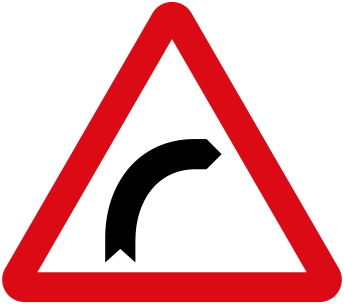
Curve Ahead
  • Triangle
  • Red
  • White
  • Black

Curve ahead

Warns that the road ahead contains a dangerous bend or a sequence of bends; the curve direction shown by the symbol indicates the first bend.

When you see it
You see this sign on the approach to a sharp single bend, a hairpin or a series of bends that cannot be read in time from the road geometry alone.
What you must do
You must reduce speed before entering the bend, stay in your lane and refrain from overtaking until the road geometry is again clear.
Tip
The direction of the curve is shown by the arrow on the sign.

Source: Vienna 1968 Section A.1a

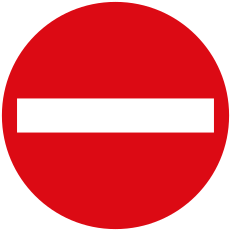
No Entry
  • Circle
  • Red
  • White

No entry

Prohibits entry to all vehicles. The sign is shown in the direction in which entry is forbidden and is most often used to mark the exit end of a one-way street or a closed road.

When you see it
You see this sign at the contraflow end of one-way streets, at closed roads, at the exit ramps of motorways viewed in the wrong direction, and at restricted-access courtyards.
What you must do
You must not enter the road past this sign. You shall turn back or follow the alternative route indicated.
Penalty
Penalties for ignoring this sign vary by country. See your country's driving guide for specifics.

Source: Vienna 1968 Section C.1

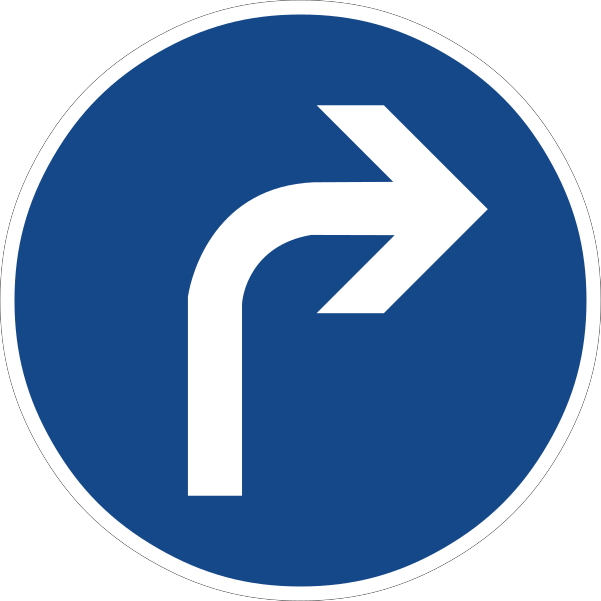
Turn Right
  • Circle
  • Blue
  • White

Turn right

Indicates the single direction in which vehicles are required to proceed past the sign — in this variant, to the right. Other arrow orientations cover left, straight, straight-or-right and straight-or-left.

When you see it
You see this sign at junctions and channelised exits where only one direction of travel is permitted, typically to keep a one-way scheme functioning or to enforce a banned manoeuvre.
What you must do
You must follow the direction shown by the arrow. You shall not proceed straight on or turn against the arrow.
Penalty
Penalties for ignoring this sign vary by country. See your country's driving guide for specifics.

Source: Vienna 1968 Section D.1a

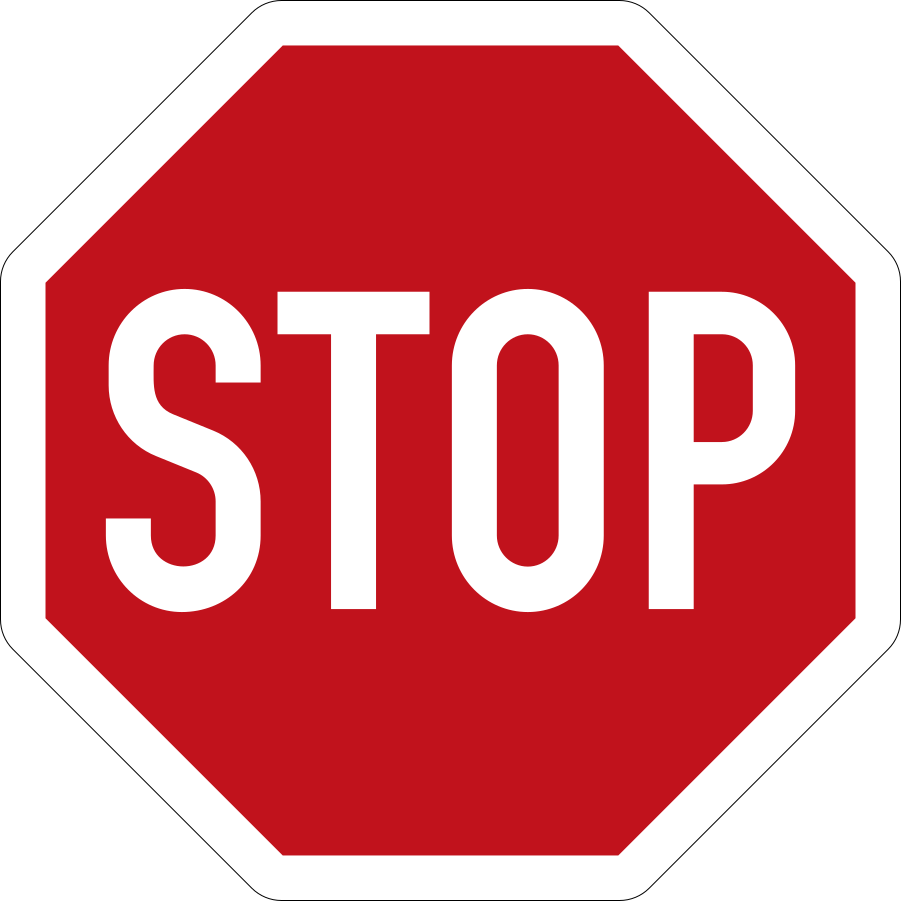
Stop
  • Octagon
  • Red
  • White

Stop

Drivers must come to a complete stop at the stop line — or, in the absence of a line, at the point where the sign offers a clear view of the intersecting road — and must give way to all traffic on the intersecting road before proceeding.

When you see it
You see this sign at junctions of minor with major roads, at railway level crossings without active warning, and at points where the intersecting road has poor visibility.
What you must do
You must bring the vehicle to a complete halt, give way to all traffic on the intersecting road, and may proceed only when the way is clear.
Country variations
Vienna 1968 Section B.2(a) defines the octagon as the standard; Section B.2(b) permits an alternative circular variant with an inset inverted triangle and the word STOP. The legend STOP is retained in most countries; local-language variants include ARRET (Quebec), ARRETEZ (Quebec/road works), DUR (Turkey) and a hand pictogram (Israel).
Penalty
Penalties for ignoring this sign vary by country. See your country's driving guide for specifics.
Tip
The only octagonal sign in Europe. Recognizable even if damaged.

Source: Vienna 1968 Section B.2a

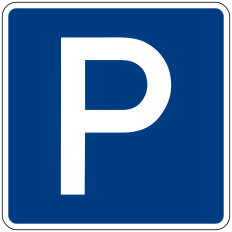
Parking
  • Rectangle
  • Blue
  • White

Parking

Indicates a place where parking is permitted. The sign carries a white letter P on a blue ground and may be supplemented by panels showing time limits, permitted users or fees.

When you see it
You see this sign at the entrance to car parks, marked on-street parking bays, motorway service areas, and any location where parking is positively authorised.
What you must do
You may park in accordance with any conditions shown on supplementary panels (time limits, disc parking, fee payment, permitted vehicle classes). Outside those conditions the permission does not apply.

Source: Vienna 1968 Section E.14a

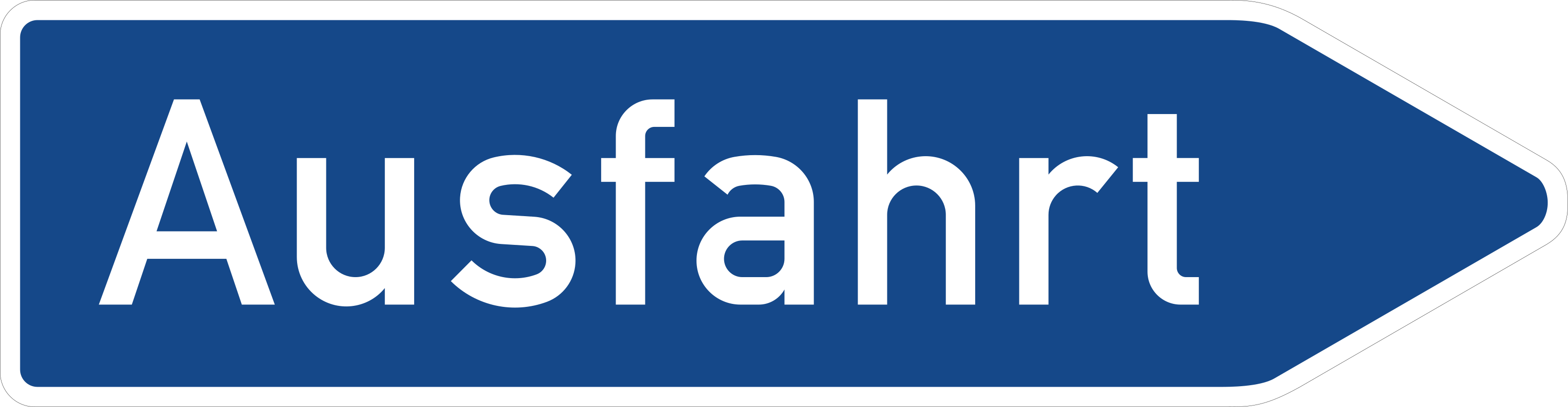
Motorway Exit
  • Rectangle
  • Blue
  • White

Motorway exit

Identifies an upcoming motorway exit by exit number, destination name and distance. On motorways the standard ground is green with white legend; on ordinary roads the ground is blue with white legend.

When you see it
In a sequence — typically at 2000m, 1000m and 500m before the exit, with a final confirmation at the gore — on motorways and grade-separated expressways.
What you must do
If you intend to take the exit you must move into the deceleration lane in good time, signal, and reduce speed only once you are clear of the through-lanes.
Country variations
Some Vienna parties (Italy, France) use white-on-green for motorways and white-on-blue for ordinary roads; others (Sweden, the Netherlands) reverse the convention so that motorways are blue. Both schemes are permitted under Section G.

Source: Vienna 1968 Section G

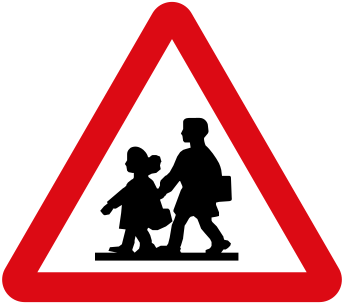
School Zone
  • Triangle
  • Red
  • White
  • Black

School zone

Marks the approach to a school. Under Vienna 1968 the standard form is the Section A.13 children-warning triangle, supplemented where necessary by a panel reading SCHOOL or by a reduced speed-limit disc. The dedicated pentagon-shaped school-zone sign is a national variant.

When you see it
You see this sign on the approach to primary and secondary schools, at school crossing patrols and on residential streets used as walking routes to school. Variable-time speed limits often apply.
What you must do
You must reduce speed to the posted school-zone limit during the hours when the limit is in force and shall be ready to stop for school crossing patrols and children entering the carriageway.
Country variations
There is no single Vienna-standard school-zone sign; the Section A.13 children triangle is used Europe-wide. The United States uses a fluorescent-yellow-green pentagon (MUTCD S1-1); Canada and Australia follow MUTCD-derived variants; the United Kingdom uses a children-on-warning-triangle (TSRGD diagram 545) plus a yellow rectangular 'SCHOOL' supplementary plate.
Penalty
Penalties for ignoring this sign vary by country. See your country's driving guide for specifics.

Source: Vienna 1968 Section A.13

Test your knowledge

Practice with official-format driving test questions featuring road signs.

Start practice test