
In this article
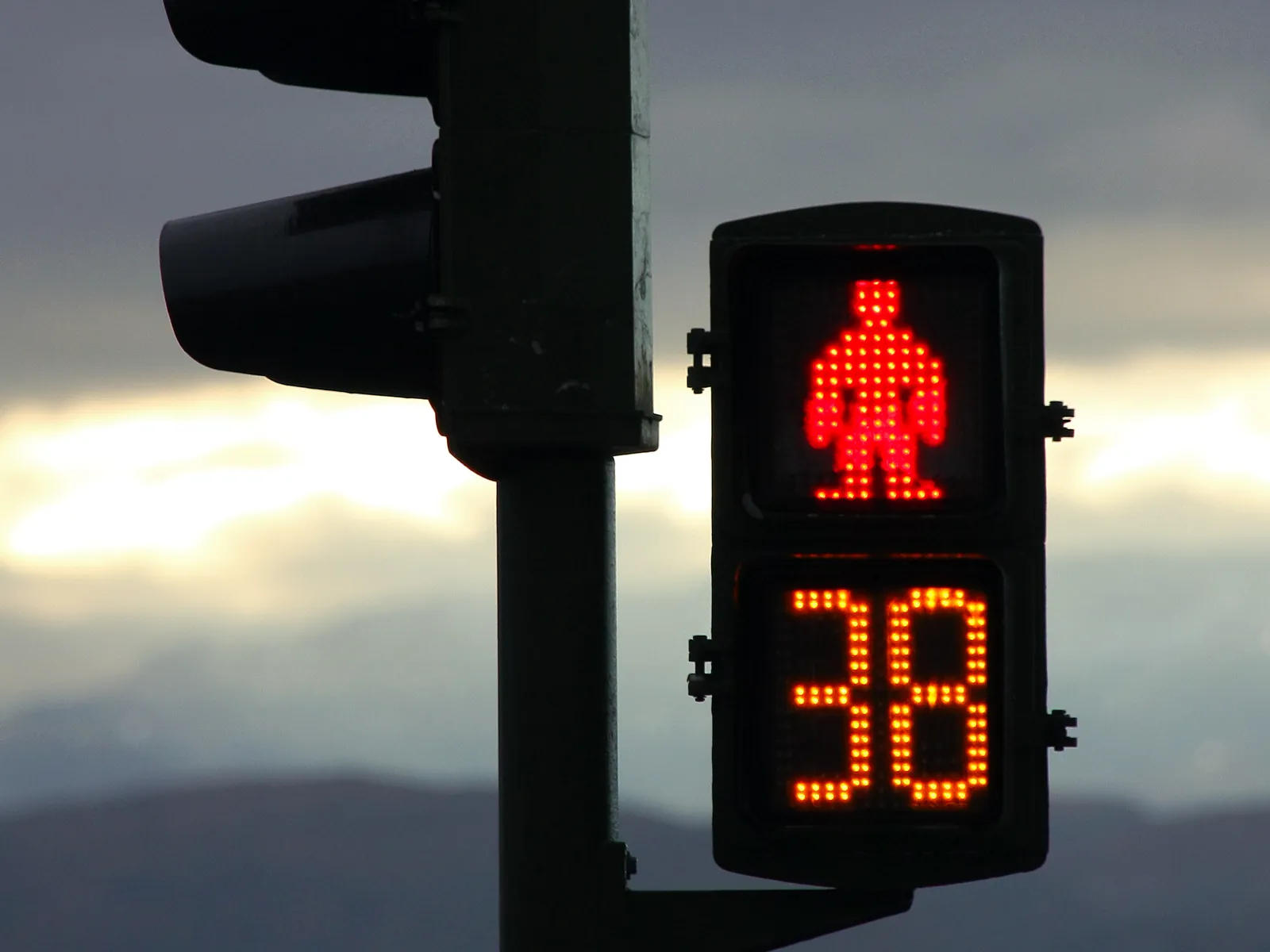
From 1st October 2026, where a crossing has its own pedestrian signal, councils may no longer show drivers a flashing amber while pedestrians have a green figure. The vehicle signal must be red. The rule comes from Royal Decree 518/2026, which the Government approved on 24th June and published in the Official State Gazette (BOE) two days later.1
If you are used to rolling through a flashing amber at a crossing while someone is on it, that light becomes a red one: 200 euros and 4 points if you drive through it.
Until now, many junctions have run the two signals together. A driver turning into a side street would see a flashing amber, meaning proceed with caution and give way, at the same moment the person stepping off the kerb saw green. The signals told both of them to go. On a wide road, or behind a bus that blocks the view, the turning driver meets the pedestrian in the middle of the crossing.
The DGT has wanted this fixed for years. In June 2022 its own magazine, Tráfico y Seguridad Vial, ran a piece under the headline "El peligro está en el ámbar", the danger is in the amber. Ana Blanco, the agency's deputy assistant director for traffic, described the overlap of a green pedestrian phase with flashing amber for vehicles as sending "mensajes contradictorios", contradictory messages. The same article counted the cost: in 2019, 47 pedestrians died and 317 were taken to hospital after being hit at a crossing with traffic lights. In 2020, a year with far less traffic, 35 died and 198 were hospitalised.4
The new rule
Most reports have paraphrased the decree. The change is one sentence, added to the part of the General Traffic Regulations that defines what each light means. It is short enough to quote in full.
As a general rule, at pedestrian crossings with a signal reserved for pedestrians, the flashing amber light for vehicles may not coincide with the steady green light for pedestrians and must be preceded by the steady red light.
ESComo norma general, en los pasos para peatones con semáforo reservado para peatones, la luz amarilla intermitente para vehículos no podrá coincidir con la luz verde no intermitente para peatones y deberá ir precedida de la luz roja no intermitente.
Two phrases limit how far this goes. "As a general rule" means the decree allows exceptions without listing them. And the sentence only covers crossings that have their own pedestrian signal. A junction where cars get a flashing amber at night and there is no pedestrian head is untouched. The 2003 wording that gives flashing amber its meaning, take extra care and give way where required, stays as it was.2
For drivers
The meaning of each light does not change. Red has always meant stop. Flashing amber has always meant slow down and give way. The sequence a council may programme does change: while pedestrians have green, the vehicle head must show red, and an amber phase can only follow a red.
The practical effect is on habit. A crossing where you used to roll through on flashing amber while someone crossed will, once the council reprogrammes it, show you a red. Driving through it the old way is then a red-light offence.
And the fine for that has not moved. Failing to respect a red light is a serious offence under article 76 of the Traffic Act, punished with 200 euros and four points off the licence. Paying within 20 calendar days of the notification halves it to 100 euros and closes the case.3 Reports pairing the new rule with a "new fine" are describing this existing penalty.
Not in the decree
Press reports have added things the text does not contain.
- No deadline for councils. The decree has transitional periods for moped helmets, motorcycle gloves and daytime lights on e-scooters. It has none for traffic signals. Reports of a "gradual rollout" describe what councils will probably do, not anything the law requires.1
- No new offence and no new fine. The penalty provisions of the Traffic Act are untouched.
- Flashing amber is not being scrapped. It keeps its meaning wherever a pedestrian signal is not involved.
- No timing rule. The text requires red before amber. It does not say how long either phase lasts.
Also in the same decree
The traffic-light sentence is one line in a decree about vulnerable road users, and the rest of it takes effect on the same date. Motorcycle and moped riders and their passengers must wear protective gloves on interurban roads and closed footwear covering the whole foot on every road. A driver overtaking a cyclist outside a built-up area must drop at least 20 km/h below the road's limit for the whole manoeuvre, on top of the existing 1.5 metre gap. And motorcycles may use the hard shoulder when traffic is at a standstill, in single file and at no more than 30 km/h.1
Our Spain 2026 rule changes page tracks each of these, with the article of the regulations behind every one.
Key facts
| Instrument | Real Decreto 518/2026, de 24 de junio (BOE-A-2026-13889) |
|---|---|
| Published | BOE no. 155, 26th June 2026 |
| In force | 1st October 2026 |
| Provision amended | Annex I, section 4.2, paragraph d) of the Reglamento General de Circulación (RD 1428/2003), by article 26 of RD 518/2026 |
| Applies to | Pedestrian crossings with a signal reserved for pedestrians |
| Rule | Flashing amber for vehicles may not coincide with steady green for pedestrians and must be preceded by steady red |
| Red-light penalty | 200 euros and 4 pointsunchanged (100 euros if paid within 20 days) |
| Deadline for councils | None in the decree |
Questions and answers
Does flashing amber disappear from Spanish traffic lights on 1st October 2026?
No. Royal Decree 518/2026 keeps the flashing amber light and its meaning: take extra care and give way where required. From 1st October 2026 it bars one combination at crossings with their own pedestrian signal: vehicles may not see flashing amber while pedestrians see steady green, and the amber phase must follow a steady red.
What is the fine for running a red light in Spain in 2026?
200 euros and 4 licence points. Failing to respect a red light is a serious offence under article 76 of the Traffic Act (Real Decreto Legislativo 6/2015), and Annex II sets the points at 4. Paying within 20 calendar days halves the fine to 100 euros. Royal Decree 518/2026 does not change this.
When does Royal Decree 518/2026 come into force?
On 1st October 2026. The Government approved it on 24th June 2026 and the BOE published it in issue 155 on 26th June 2026.
Do councils have a deadline to reprogramme their traffic lights?
The decree sets none. It contains transitional periods for moped helmets, motorcycle gloves and daytime lights on e-scooters, and no transitional period for traffic signals.
Which part of the Spanish traffic regulations changes?
Paragraph d) of section 4.2 of Annex I to the Reglamento General de Circulación (Royal Decree 1428/2003), amended by article 26 of Royal Decree 518/2026. One sentence is added; the existing wording stays.
What else does Royal Decree 518/2026 change on 1st October 2026?
Motorcycle and moped riders and passengers must wear protective gloves on interurban roads and closed footwear on every road (article 118 of the regulations). A driver overtaking a cyclist outside a built-up area must reduce speed by at least 20 km/h below the road's limit (article 85). Motorcycles may use the hard shoulder when traffic is stopped, in single file at up to 30 km/h (article 36).
We read every claim in this article against the BOE text of the decree, the consolidated Traffic Act and the DGT magazine article listed below. We used press coverage only to find them.
Quote freely with a link. Figures and legal text should be attributed to the primary sources listed above.
AutoviaTest (10th September 2026). From 1st October 2026, Spanish traffic lights must show drivers a red light while pedestrians cross. https://autoviatest.com/en/spain/news/spain-changes-traffic-light-rules-from-october-what-drivers-need-know
Spotted an error? Read how we verify and correct our reporting.Editorial guidelines