Informative Signs
Provide useful information about facilities, services, and locations.
6 signs in this category
About Informative Signs
Informational signs are defined in Annex 1, Sections E (special-regulation signs) and F (signs giving information on facilities or services) of the 1968 Vienna Convention on Road Signs and Signals. The standard shape across both sections is a rectangle of varying aspect ratio. Section E signs use a blue ground for regulatory information such as parking permitted (Section E.14a), pedestrian crossing location (Section E.12a), one-way street (Section E.3), hospitals (Section E.13), bus and tramway stops (Section E.15) and emergency stopping places (Section E.18).
Section F signs use a blue ground with an inset white square containing a black pictogram for facilities — filling stations (Section F.4), hotels or motels (Section F.5), restaurants (Section F.6), telephones (Section F.3) and emergency telephones the Convention. The defining driver-action principle of these sections is that the signs neither restrict nor command but inform: they tell the driver where something is permitted, where a facility can be found, or where a special regime begins. Where a Section E sign establishes a regulatory regime (for example, the beginning of a pedestrian zone or a one-way street), that regime is binding from the sign onward until cancelled.
All Informative Signs
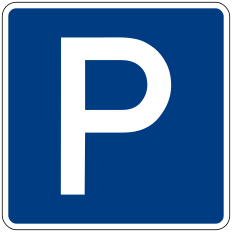
Parking
Indicates a place where parking is permitted. The sign carries a white letter P on a blue ground and may be supplemented by panels showing time limits, permitted users or fees.
- When you see it
- You see this sign at the entrance to car parks, marked on-street parking bays, motorway service areas, and any location where parking is positively authorised.
- What you must do
- You may park in accordance with any conditions shown on supplementary panels (time limits, disc parking, fee payment, permitted vehicle classes). Outside those conditions the permission does not apply.
Source: Vienna 1968 Section E.14a
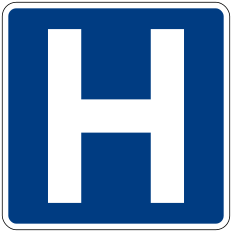
Hospital
Indicates that a hospital is located nearby. The sign is intended to alert drivers to the presence of a facility where unusual noise should be avoided and where ambulance traffic may be frequent.
- When you see it
- You see this sign on the approach to and around hospitals, often together with directional panels showing the route to emergency or general entrances.
- What you must do
- You shall avoid unnecessary use of the horn, must give way to clearly identified ambulances, and are required to observe any reduced speed limit posted in the vicinity.
- Country variations
- The pictogram varies: the historical Vienna form uses a red cross or a stylised H, while some parties (notably Spain and Portugal) use a white H on blue with no cross to avoid Red Cross trademark concerns.
Source: Vienna 1968 Section E.13
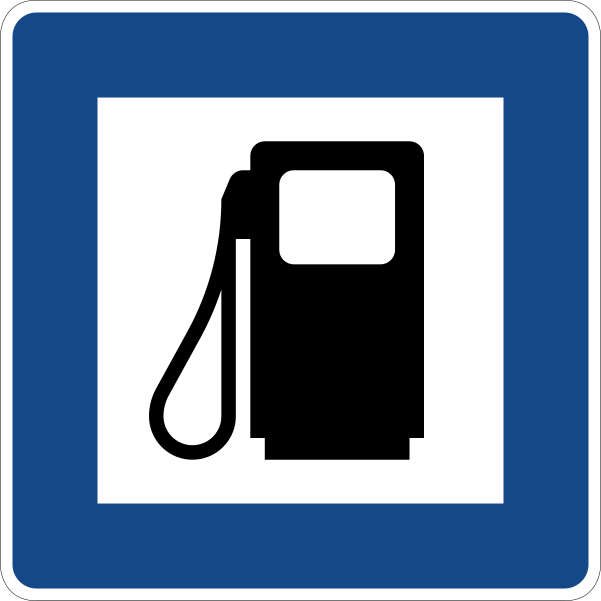
Gas Station
Indicates a filling station — a facility selling motor fuel — accessible from the road. The pictogram is a stylised fuel pump in black on a white inset square.
- When you see it
- You see this sign on motorway approach panels, at the entrance to service areas, and on rural roads to mark the next available filling station, often with distance information on a supplementary panel.
- What you must do
- You may leave the main road to use the facility; the sign does not in itself impose any restriction. You shall remain alert to merging traffic re-entering the carriageway.
Source: Vienna 1968 Section F.4
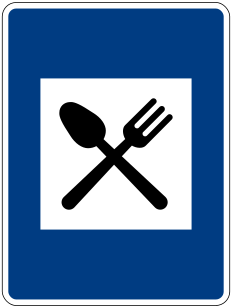
Restaurant
Indicates a restaurant accessible from the road. The pictogram is a stylised crossed knife and fork in black on a white inset square; in some parties a separate sign with a coffee cup (Section F.7) is used for cafeterias and snack bars.
- When you see it
- You see this sign on motorway approach panels for service areas with dining, at the exits leading to roadside restaurants and rest stops, and on rural primary roads to mark facilities, often with distance information on a supplementary panel.
- What you must do
- You may leave the main road to use the facility; the sign imposes no driving restriction in itself. You shall remain alert to slow-moving and merging traffic at the access point.
Source: Vienna 1968 Section F.6
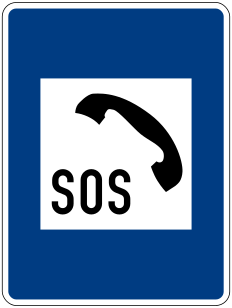
Emergency Telephone
Indicates an emergency telephone available for road users in distress. The pictogram is a stylised telephone handset in black on a white inset square; on motorways it is typically supplemented by a directional arrow showing the nearest SOS call point.
- When you see it
- You see this sign at intervals along motorways and major trunk roads to mark the nearest roadside SOS call box, and in tunnels at each of the manned or unmanned emergency niches.
- What you must do
- You may use the indicated telephone to summon emergency assistance in case of accident or breakdown. You shall remain on the hard shoulder or in a safe refuge while making the call and must not cross live traffic lanes.
- Country variations
- Many Vienna parties have retained the the Convention sign even where mobile coverage has made the physical SOS phone largely redundant; the symbol now also serves as an indication of the emergency-call number 112 within the EU.
Source: Vienna Convention on Road Signs and Signals, 1968

Information Point
Indicates a tourist information point accessible from the road. The pictogram is a lowercase letter 'i' in black (or, in some parties, white on blue) on a white inset square.
- When you see it
- You see this sign at the entry to towns, near tourist offices, at motorway service areas with information desks, and on rural primary roads leading to regional information centres.
- What you must do
- You may leave the main road to use the facility; the sign imposes no driving restriction in itself. You shall remain alert to slow-moving and merging traffic at the access point.
Source: Vienna Convention on Road Signs and Signals, 1968
Key Information About Informative Signs
How to Recognize
Informational signs are rectangular with blue or green backgrounds. They provide helpful information.
Required Action
Use the information provided to make informed decisions about your journey.
Penalties
Generally no direct penalties, but ignoring them may lead to indirect issues.
Explore Other Categories


Ready to Ace Your Driving Test?
Everything you need to pass on your first attempt
- 30+ Practice Tests
- 16 Lessons
- Progress Tracking
- Tess AI Coach