Prohibitory Signs
Indicate actions that are not permitted. Usually circular with red border.
7 signs in this category
About Prohibitory Signs
Prohibitory or restrictive signs are defined in Annex 1, Section C of the 1968 Vienna Convention on Road Signs and Signals. The standard shape is a circular disc with a white or pale-yellow ground and a wide red border; the prohibited action is shown in black inside the disc and may be struck through with a red diagonal bar where the symbol alone would be ambiguous. Section C covers entry prohibitions (Section C.1 no entry), overtaking prohibitions (Section C.13a, and Section C.13b for goods vehicles), maximum speed (Section C.14), axle-load and gross-weight limits, no parking (Section C.18) and no stopping (Section C.19), among many others.
The defining driver-action principle of Section C is that the depicted action is forbidden from the sign until either an end-of-restriction sign cancels the obligation, the next intersection ends it implicitly, or a supplementary panel restricts the prohibition to a stated distance or set of vehicle classes. Compliance is mandatory and enforceable on the spot; the sign creates an immediate legal duty rather than an advisory warning, and breach of a Section C sign is a primary traffic offence in every Vienna party.
All Prohibitory Signs
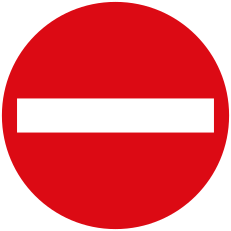
No Entry
Prohibits entry to all vehicles. The sign is shown in the direction in which entry is forbidden and is most often used to mark the exit end of a one-way street or a closed road.
- When you see it
- You see this sign at the contraflow end of one-way streets, at closed roads, at the exit ramps of motorways viewed in the wrong direction, and at restricted-access courtyards.
- What you must do
- You must not enter the road past this sign. You shall turn back or follow the alternative route indicated.
- Penalty
- Penalties for ignoring this sign vary by country. See your country's driving guide for specifics.
Source: Vienna 1968 Section C.1
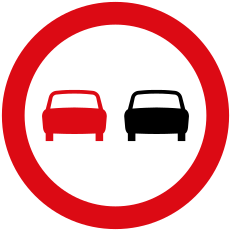
No Overtaking
Prohibits overtaking of motor vehicles other than two-wheeled mopeds and two-wheeled motorcycles without a sidecar; the prohibition runs from the sign until cancelled by an end-of-prohibition sign or an intersection.
- When you see it
- You see this sign on two-lane rural roads near bends, hill crests, bridges and other stretches where forward visibility is insufficient for a safe overtaking manoeuvre.
- What you must do
- You must not overtake any car, truck or bus while the prohibition is in force. You shall remain in lane until the restriction ends.
- Penalty
- Penalties for ignoring this sign vary by country. See your country's driving guide for specifics.
Source: Vienna 1968 Section C.13a
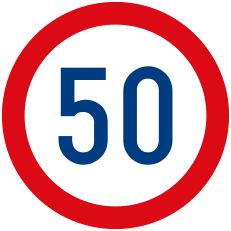
Speed Limit 50
Sets the maximum permitted speed in kilometres per hour (or miles per hour in jurisdictions that use imperial units) shown by the numeral on the disc. The limit runs from the sign until cancelled.
- When you see it
- You see this sign at the entrance to lower-speed environments such as built-up areas, school approaches, road-works zones and tighter rural sections; 50 km/h is the standard urban default in most Vienna parties.
- What you must do
- You must not exceed the indicated speed at any point past the sign until a higher limit, an end-of-restriction sign or an applicable area-default cancels it.
- Country variations
- The treaty permits any numerical value on a Section C.14 disc; 50 km/h is the most common urban posting across European parties and is the default urban limit under Article 13 of the 1968 Convention on Road Traffic.
- Penalty
- Penalties for ignoring this sign vary by country. See your country's driving guide for specifics.
Source: Vienna 1968 Section C.14
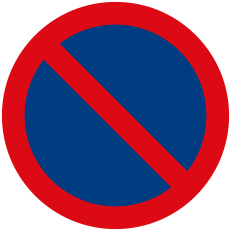
No Parking
Prohibits parking on the side of the road where the sign is displayed. Stopping for the immediate boarding or alighting of passengers or for loading and unloading remains permitted.
- When you see it
- You see this sign on urban streets where standing vehicles would obstruct traffic flow, near junctions, on narrow carriageways, and at frontages requiring kerb access.
- What you must do
- You must not leave your vehicle unattended past the sign. You may stop only long enough to board, alight or load.
- Penalty
- Penalties for ignoring this sign vary by country. See your country's driving guide for specifics.
Source: Vienna 1968 Section C.18
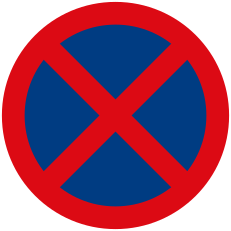
No Stopping
Prohibits both stopping and parking on the side of the road where the sign is displayed. The restriction is stricter than Section C.18 in that it forbids even momentary halts for boarding or loading.
- When you see it
- You see this sign on motorway shoulders, in tunnels, on bridges, near pedestrian crossings, and on narrow streets where any standing vehicle would create a safety hazard.
- What you must do
- You must not bring your vehicle to a stop at the kerb past this sign except where forced to do so by traffic conditions, accident or mechanical failure.
- Penalty
- Penalties for ignoring this sign vary by country. See your country's driving guide for specifics.
Source: Vienna 1968 Section C.19
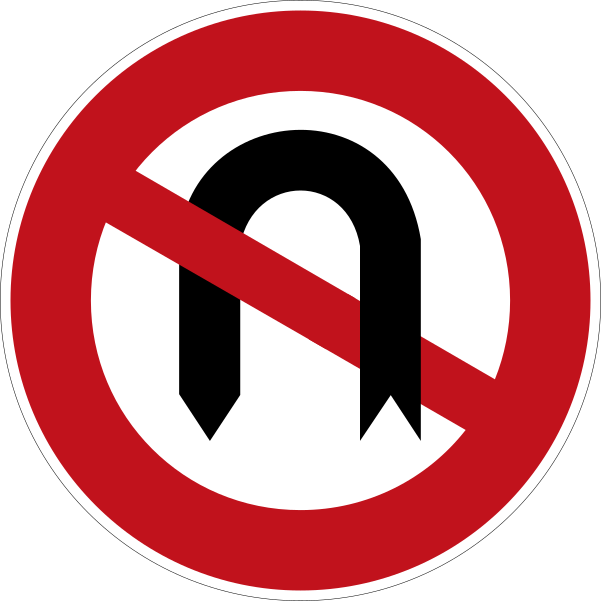
No U-Turn
Prohibits U-turns (half-turns to reverse direction of travel) on the road from the sign until the next intersection or the corresponding end-of-prohibition sign. The pictogram is a U-shaped black arrow with a red diagonal bar.
- When you see it
- You see this sign on multi-lane urban roads with central reservations, at signalised junctions where U-turns would conflict with cross-traffic, and on motorway-grade roads where reversing direction is forbidden.
- What you must do
- You must not execute a U-turn past this sign. You shall continue ahead to the next permitted turning point or roundabout to reverse direction.
- Penalty
- Penalties for ignoring this sign vary by country. See your country's driving guide for specifics.
Source: Vienna 1968 Section C.12
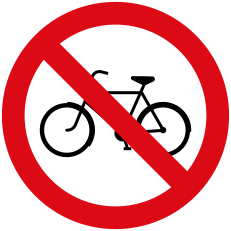
No Bicycles
Prohibits cycles (pedal bicycles) from the road or path on which the sign is displayed. The pictogram is a black bicycle silhouette inside a red-bordered circle.
- When you see it
- You see this sign at the entry to motorways, expressways, road tunnels and other infrastructure unsuited to cycle traffic, and at the entrance to footways and pedestrian-only zones where cycling is forbidden.
- What you must do
- You must not cycle past this sign. Riders shall dismount and walk if they need to continue along the prohibited section, or follow any signed cycle diversion.
- Penalty
- Penalties for ignoring this sign vary by country. See your country's driving guide for specifics.
Source: Vienna 1968 Section C.3c
Key Information About Prohibitory Signs
How to Recognize
Prohibitory signs are circular with a red border and often a diagonal red line. They show what you cannot do.
Required Action
You must not perform the indicated action. Violating these signs results in penalties.
Penalties
Fines range from 100-600 EUR depending on the violation. May include license points.
Explore Other Categories
Ready to Ace Your Driving Test?
Everything you need to pass on your first attempt
- 30+ Practice Tests
- 16 Lessons
- Progress Tracking
- Tess AI Coach