Zone Signs
Indicate special areas like school zones, pedestrian areas, and work zones.
About Zone Signs
Zone and special-regulation signs form a hybrid category drawn from Annex 1, Section E of the 1968 Vienna Convention on Road Signs and Signals and from national supplements outside the Convention. Vienna Section E.17a defines the entry to a pedestrian zone using a rectangular blue panel showing pedestrians and, where appropriate, an inscription; Vienna Section E.7 defines the entry to a built-up area. Other zone regimes — notably low-emission zones (Umweltzone in Germany, ZFE in France, Area C in Italy, ULEZ in the United Kingdom) and most North American school zones — are not standardised in the 1968 Convention and instead rely on national regulations such as the German StVO Zeichen 270.1 or the United States MUTCD S1-1 pentagonal school-zone sign.
The defining driver-action principle of zone signs is areal: the depicted rule applies throughout an extended area rather than at a single point, and remains in force until a corresponding end-of-zone sign cancels it.
All Zone Signs
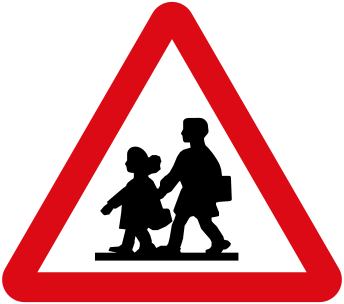
School Zone
Marks the approach to a school. Under Vienna 1968 the standard form is the Section A.13 children-warning triangle, supplemented where necessary by a panel reading SCHOOL or by a reduced speed-limit disc. The dedicated pentagon-shaped school-zone sign is a national variant.
When you see it
You see this sign on the approach to primary and secondary schools, at school crossing patrols and on residential streets used as walking routes to school. Variable-time speed limits often apply.
What you must do
You must reduce speed to the posted school-zone limit during the hours when the limit is in force and shall be ready to stop for school crossing patrols and children entering the carriageway.
Country variations
There is no single Vienna-standard school-zone sign; the Section A.13 children triangle is used Europe-wide. The United States uses a fluorescent-yellow-green pentagon (MUTCD S1-1); Canada and Australia follow MUTCD-derived variants; the United Kingdom uses a children-on-warning-triangle (TSRGD diagram 545) plus a yellow rectangular 'SCHOOL' supplementary plate.
Source: Vienna 1968 Section A.13
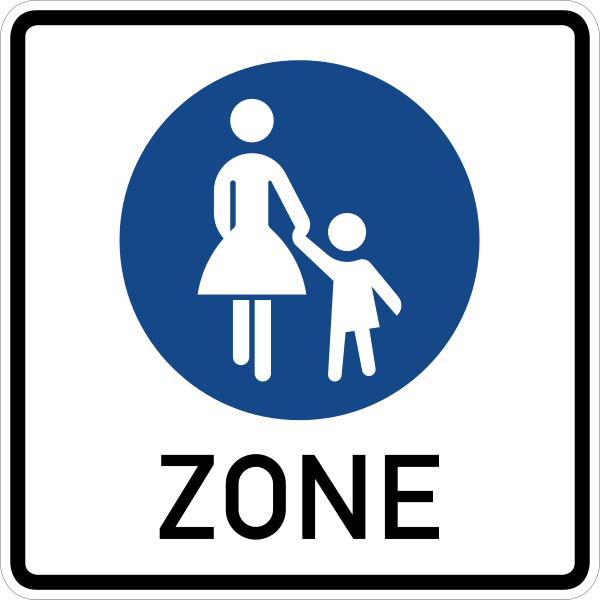
Pedestrian Zone
Marks the entry to a pedestrian zone in which the road is reserved for pedestrians. Vehicle access is permitted only for residents, deliveries within posted hours, or emergency services, and only at walking pace.
When you see it
You see this sign at the entry to pedestrianised town-centre streets, market squares and shopping precincts in European cities. The end of the zone is shown by the corresponding Section E.17(b) sign with a diagonal bar.
What you must do
You must not enter the zone unless you fall within an explicitly permitted exception. Where entry is permitted you shall travel at walking pace and must give way to pedestrians at all times.
Source: Vienna 1968 Section E.17(a)
Key Information About Zone Signs
How to Recognize
Special zone signs vary in shape but indicate areas with specific rules or restrictions.
Required Action
Observe the specific rules that apply in the indicated zone.
Penalties
Penalties vary by zone type. School zones often have doubled fines.
Ready to Ace Your Driving Test?
Everything you need to pass on your first attempt
30+ Practice Tests
Real exam questions
Tess AI Coach
Personalized guidance
16 Lessons
Interactive learning
Progress Tracking
Performance insights