Mandatory Signs
Indicate required actions or directions. Usually circular with blue background.
About Mandatory Signs
Mandatory signs are defined in Annex 1, Section D of the 1968 Vienna Convention on Road Signs and Signals. The standard shape is a circular disc with a blue ground and the prescribed symbol in white; in jurisdictions that prefer the alternative form, a white disc with a red border and a black symbol may be used and is equally valid under the Convention. Section D covers compulsory directions of travel (Section D.1a turn or proceed straight on), compulsory roundabout circulation (Section D.3), the pass-this-side indication on splitter islands and obstacles (Section D.2), compulsory cycle, footpath and equestrian lanes (Section D.4 to Section D.8), snow-chain requirements (Section D.9) and minimum speed (Section D.10).
The defining driver-action principle of Section D is positive obligation: the sign requires the driver to perform a specific action — turn in a given direction, circulate around the central island, maintain at least the indicated speed, fit snow chains — rather than merely refrain from one. The obligation applies from the sign until cancelled by a corresponding end-of-mandate sign, the next intersection, or a supplementary panel that limits its scope.
All Mandatory Signs
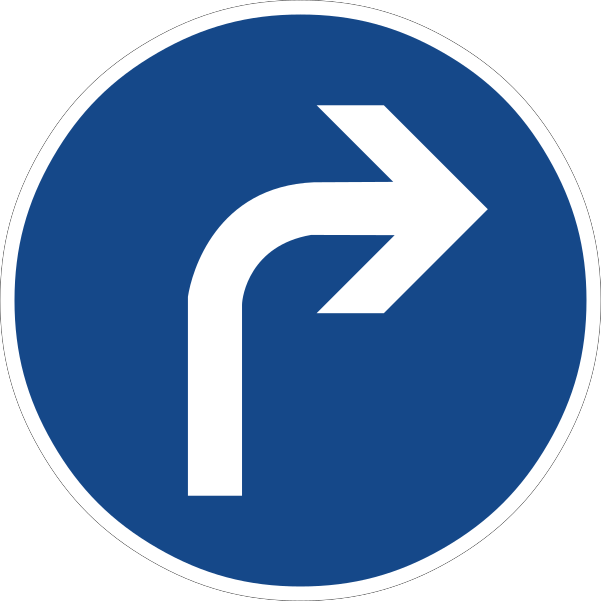
Turn Right
Indicates the single direction in which vehicles are required to proceed past the sign — in this variant, to the right. Other arrow orientations cover left, straight, straight-or-right and straight-or-left.
When you see it
You see this sign at junctions and channelised exits where only one direction of travel is permitted, typically to keep a one-way scheme functioning or to enforce a banned manoeuvre.
What you must do
You must follow the direction shown by the arrow. You shall not proceed straight on or turn against the arrow.
Source: Vienna 1968 Section D.1(a)
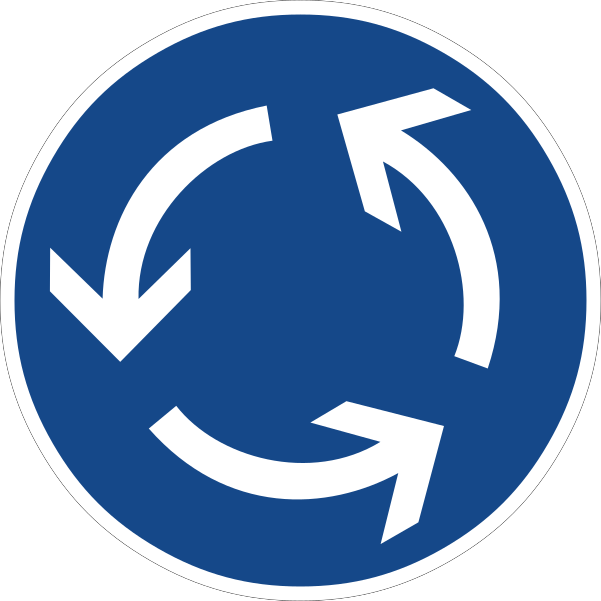
Roundabout
Indicates a compulsory roundabout. Drivers are required to circulate in the direction shown by the three white arrows arranged in a ring on the blue disc.
When you see it
You see this sign at the entry to a roundabout, typically together with a Section B.1 give-way sign that allocates priority to traffic already on the ring.
What you must do
You must enter the roundabout in the direction shown by the arrows, give way to circulating traffic in accordance with the accompanying Section B.1 sign, and shall not cross the central island.
Country variations
In right-hand-drive jurisdictions (United Kingdom, Ireland, Australia, India, southern Africa) the arrows on the disc run clockwise; in right-hand-traffic jurisdictions they run anticlockwise.
Source: Vienna 1968 Section D.3
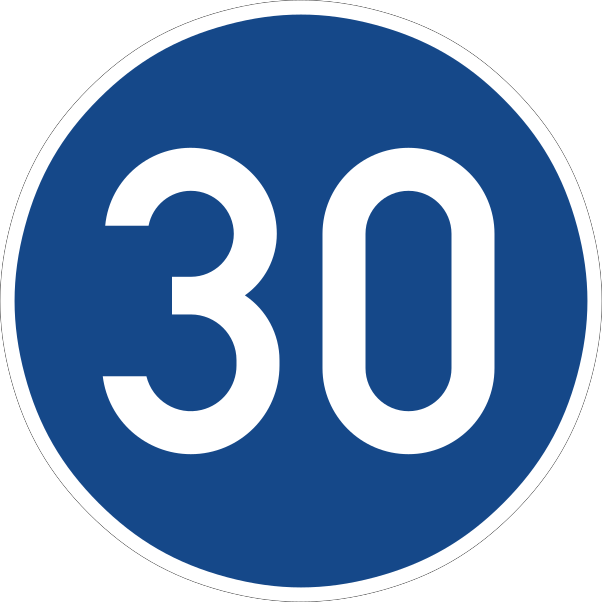
Minimum Speed
Sets the minimum speed that vehicles must maintain in kilometres per hour shown by the white numeral on the blue disc. The obligation runs from the sign until cancelled by an end-of-minimum-speed sign.
When you see it
You see this sign on motorways and high-speed expressways at lane entries reserved for through-traffic, and in tunnels where slow-moving vehicles would create a hazard.
What you must do
You must travel at or above the indicated speed unless traffic conditions, weather or the upper speed limit make doing so unsafe. Vehicles incapable of maintaining the minimum shall not enter.
Source: Vienna 1968 Section D.10
Key Information About Mandatory Signs
How to Recognize
Mandatory signs are circular with a blue background and white symbols. They show what you must do.
Required Action
You must follow the indicated instruction. These are not optional.
Penalties
Failure to comply can result in fines of 100-400 EUR and license points.
Explore Other Categories
Ready to Ace Your Driving Test?
Everything you need to pass on your first attempt
30+ Practice Tests
Real exam questions
Tess AI Coach
Personalized guidance
16 Lessons
Interactive learning
Progress Tracking
Performance insights