 Tourist driving guide
Driving in Madrid
Your complete guide to driving and renting scooters in Madrid, Spain. Learn about IDP requirements, traffic rules, safety tips, and everything you need to know before hitting the road.
 AutoviaTest.com
International Driving Permit (IDP) in Madrid
Required for non-EU
EU/EEA licences are valid in Spain while in date. Non-EU visitors can drive on a valid home licence during a tourist stay, but should carry an International Driving Permit (IDP) with it, as a non-EU licence is only recognised alongside an IDP or an official Spanish translation. The 6-month limit applies once you become a Spanish resident: after that you must exchange your licence (if your country has an agreement with Spain) or pass the full Spanish test. The US, Canada and Australia have no exchange agreement, so their residents must take the Spanish test.
Accepted licenses
- EU/EEAvalid
- Non-EUlicence + IDP
- UStourists only
Scooter & motorbike rental in Madrid
Daily scooter rental
€20-40/day
License required
You need a motorcycle licence (A1 or A) to ride a 125cc scooter. Spain lets holders of a Spanish car licence ride 125cc after holding it 3 years, but this applies only to Spanish licences inside Spain and does NOT cover a foreign car licence. Visitors without a motorbike licence should choose a 50cc moped or an electric scooter.
Rental tips
- Madrid has many electric scooter and moped rental options (eCooltra, Acciona)
- Watch for bike lanes and bus/taxi lanes - don't ride in them
- The whole city is a Low Emission Zone - older bikes face restrictions
- The historic centre (La Latina, Lavapiés) has narrow, busy streets
- Motorbike parking is far easier than finding a car space
Insurance warning
Third-party insurance minimum. Comprehensive recommended.
Traffic rules in Madrid
Local traffic rules
The whole city is a Low Emission Zone (ZBE Madrid): cars with no DGT eco-label are banned 24/7, and the central Distrito Centro and Plaza Elíptica zones allow only residents and ECO/zero-emission cars
Foreign-plated cars must register with the city before entering the central Distrito Centro zone
Most streets are limited to 30 km/h (one lane each way); avenues with two or more lanes per direction are 50 km/h; the M-30 ring road is 70-90 km/h
Bus and taxi lanes are camera-enforced - do not drive in them
SER paid parking applies Mon-Fri 09:00-21:00 and Sat 09:00-15:00 (free Sundays and holidays)
Common tourist mistakes
- Driving a no-label (sin etiqueta) car into the city, or a foreign car into Distrito Centro without registering first
- Overstaying the SER limit (max 2h in green zones, 4h in blue)
- Entering pedestrianised central streets such as Puerta del Sol
- Speeding in 30 km/h zones
- Driving a Spanish-registered car without the connected V16 emergency beacon (mandatory since 2026 - rental cars should already carry one)
Horn culture
Minimal. Honking is considered rude except for safety.
Traffic fines & penalties (Spain)
Safety tips
Essential safety tips
- Madrid is safe for driving by European standards
- Watch for cyclists, mopeds and e-scooters, especially in the centre
- Historic-centre streets (La Latina, Lavapiés) are narrow and busy
- Don't leave valuables visible in parked cars
- The metro is usually faster than driving across the city
Best time to drive
Early morning or after 8 PM
Seasonal weather warning
Summers are very hot (often 38–40 °C), so use air-con and stay alert to fatigue. Spring and autumn bring occasional heavy storms; snow is rare but possible in winter.
Areas to avoid (for beginners)
- Puerta del Sol (pedestrianised, no driving)
- Distrito Centro low-emission zone (residents and ECO/zero cars only)
- Gran Vía during rush hour (congested, 30 km/h, frequent restrictions)
Parking
Madrid's on-street parking is the SER (Servicio de Estacionamiento Regulado), run by the city, and the kerb is colour-coded blue and green. Charges apply Monday to Friday 09:00-21:00 and Saturday 09:00-15:00 (free on Sundays and public holidays). Every tariff scales with your car's DGT environmental label, so cleaner cars pay less and zero-emission cars park free; a car not in the DGT database is charged the higher Class B rate. Remember the whole city is a Low Emission Zone, so check your car's eco-label before driving in - most visitors simply use an underground car park or leave the car on the outskirts and take the metro.
On-street parking zones
| Zone | Who can park | Rate | Max stay | Hours |
|---|---|---|---|---|
| Zona Azul (blue) | Anyone may park | approx. EUR 1-3/h (scales by eco-label) | 4 hours | Mon-Fri 09:00-21:00, Sat 09:00-15:00 |
| Zona Verde (green) | Residents (no time limit) and visitors (higher rate) | Residents cheap permit; visitors approx. EUR 2/h | Visitors 2 hours | Mon-Fri 09:00-21:00, Sat 09:00-15:00 |
| High-rotation (alta rotación) | Anyone, short stops | Standard SER rate | 45 minutes | Mon-Fri 09:00-21:00, Sat 09:00-15:00 |
| Off-street car parks | Anyone | approx. EUR 3-4/h, cheaper daily rates | No limit | Usually 24/7 |
| Free / outside SER hours | Anyone | Free | No limit | Sundays, holidays, nights, unmarked streets |
Average cost
€1-3/hScooter parking
Free motorbike parking bays across the city. Much easier than finding a car space.
Parking tips
- Zona Azul (blue) = anyone, max 4 hours; Zona Verde (green) = residents have no time limit, visitors up to 2 hours at a higher rate
- Pay at the street meters or an authorised app (ElParking, EasyPark, Parclick); rates rise the more polluting your car is
- Zero-emission cars park free; no-label cars cannot legally enter the city at all
- SER is free on Sundays, public holidays, and outside its hours
- An underground car park or a park-and-ride on the outskirts plus the metro is easiest
Where to park
Madrid
Where to park
Renting a car in Madrid?
We may earn a commission from bookings made through this link, at no extra cost to you.
FAQ: Driving in Madrid
Do I need a car in Madrid?
No. Madrid has an excellent metro and bus network and a walkable centre. A car is only really useful for day trips outside the city, such as Toledo, Segovia or El Escorial.
What is the ZBE (Low Emission Zone) in Madrid?
Since January 2025 the entire city of Madrid is a Zona de Bajas Emisiones: cars with no DGT environmental label are banned 24/7 and enforced by camera. The central Distrito Centro and Plaza Elíptica zones are stricter still, allowing only residents and ECO/zero-emission cars. Foreign-plated cars must register with the city before entering Distrito Centro, and violations are fined EUR 200 (EUR 100 if paid promptly).
Can I use my US license in Madrid?
Yes, US licences are accepted for a tourist stay - carry an International Driving Permit (IDP) alongside it. US residents who settle in Spain have no exchange agreement, so after 6 months of residency they must pass the full Spanish test.
Is it hard to drive in Madrid?
Challenging in the centre, easy outside the M-30. The main challenges are the city-wide low-emission zone, the restricted historic centre and finding parking; the M-30 ring road and the outskirts are straightforward.
Are scooters a good option in Madrid?
Yes. Scooters and mopeds are popular and practical, with widely available electric rentals and far easier parking than cars.
Can you pass the test?
Try a few real practice questions
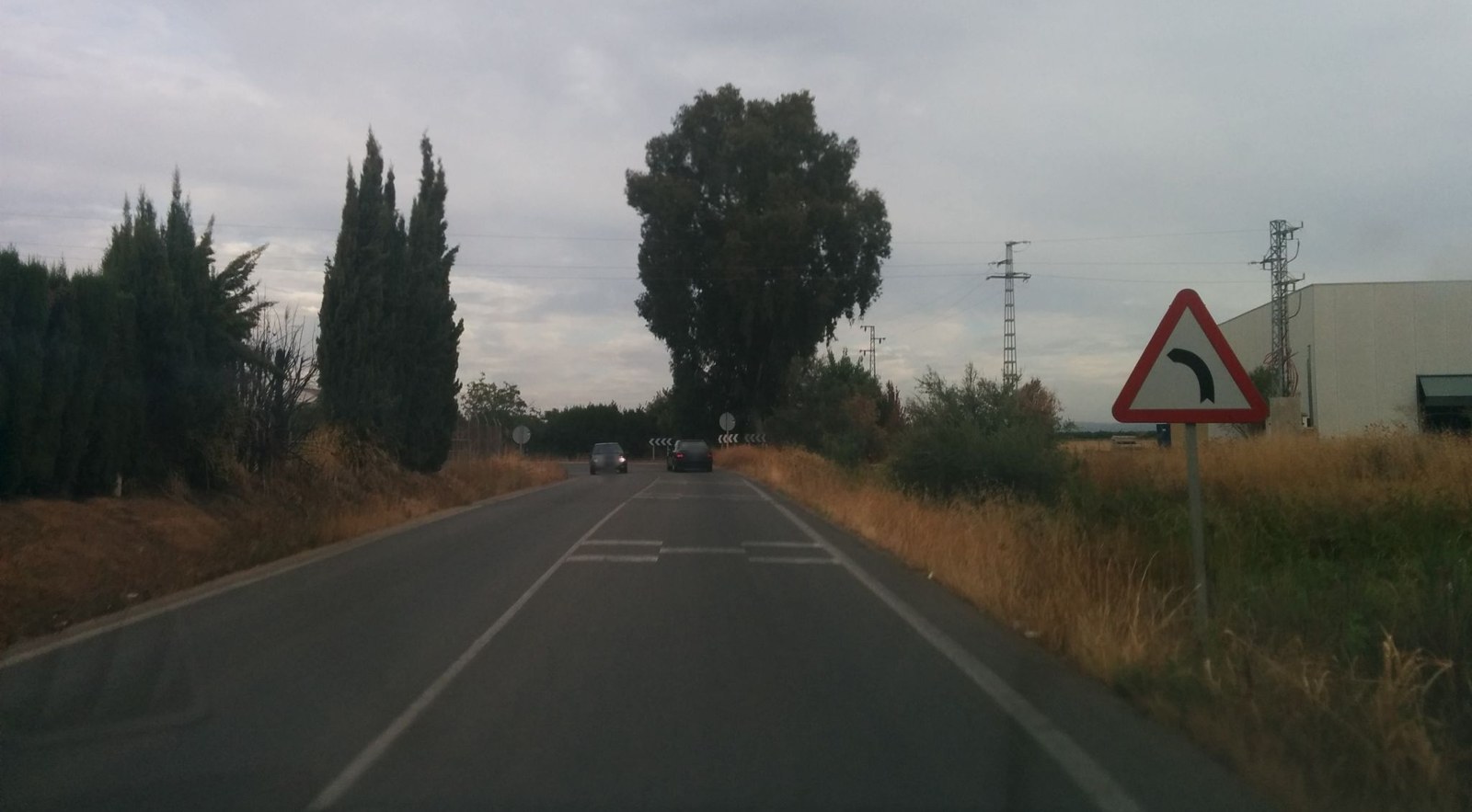
You are driving along this road towards the chevrons. What does the sign on the right warn you about?
No signup required.
Emergency contacts
Practice for your Spain driving test
Prepare for the official driving theory test with practice questions, road signs, and study materials.