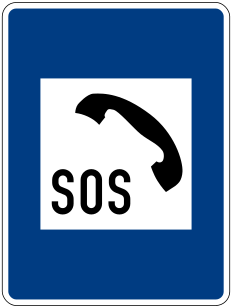
About informational signs
Informational signs are defined in Annex 1, Sections E (special-regulation signs) and F (signs giving information on facilities or services) of the 1968 Vienna Convention on Road Signs and Signals. The standard shape across both sections is a rectangle of varying aspect ratio. Section E signs use a blue ground for regulatory information such as parking permitted (Section E.14a), pedestrian crossing location (Section E.12a), one-way street (Section E.3), hospitals (Section E.13), bus and tramway stops (Section E.15) and emergency stopping places (Section E.18).
Section F signs use a blue ground with an inset white square containing a black pictogram for facilities — filling stations (Section F.4), hotels or motels (Section F.5), restaurants (Section F.6), telephones (Section F.3) and emergency telephones the Convention. The defining driver-action principle of these sections is that the signs neither restrict nor command but inform: they tell the driver where something is permitted, where a facility can be found, or where a special regime begins. Where a Section E sign establishes a regulatory regime (for example, the beginning of a pedestrian zone or a one-way street), that regime is binding from the sign onward until cancelled.